
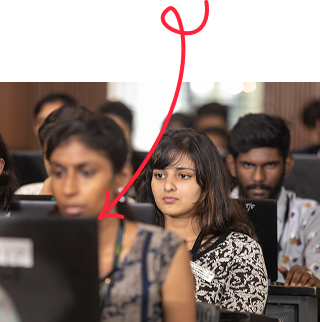
Overview
Data Science is a data-driven discipline that brings together computer science with a focus on machine learning and algorithms, mathematics, statistics, and business or domain knowledge. It is all about extracting meaningful insights from large volumes of data using modern tools and techniques, identifying hidden patterns, and enabling informed business decisions.
The MSc Data Science program is designed for aspiring data scientists to develop core skills in machine learning, deep learning, data visualization, and cloud computing.
What You’ll Learn
- Artificial Intelligence and Machine Learning
- Cloud Computing
- Big Data technologies (Hadoop, Spark)
- NoSQL databases
- Deep learning and NLP
- Blockchain technology
- Internet of Things(IoT)
- Data Structures
- Algorithms to support advanced data analysis and modeling.
Practical Skills
With a strong emphasis on application-oriented learning and industry-relevant coursework, graduates of the MSc Data Science program develop strong
- Analytical skills
- Programming skills
- Data-driven problem-solving skills
- They become capable of acquiring, managing, and analyzing large-scale data, building and deploying machine learning models, developing data-driven applications, and applying statistical and computational techniques to real-world problems.
Career Pathways
- Data Science Analyst
- Data Science Engineer
- Data Analyst
- Business analyst
- Research Analyst
- Application Engineer
Programme Education Objectives
| PEOs | Programme Educational Objectives |
|---|---|
| PEO1 | To develop in-depth understanding of the key technologies in Data Science. |
| PEO2 | To gain ability to design integrated solutions to problems by applying principles of Data Science. |
| PEO3 | To provide strong core training both theoretically and practically to create adept data scientists. |
| PEO4 | To gain exposure to real-world problems in order to adapt easily to the industry demands. |
| PEO5 | To inculcate values and make students realize the significance of ethics in a professional environment. |
Programme Outcomes (POs)
| POs | Programme Outcomes |
|---|---|
| PO1 | Apply Quantitative modeling and Data analysis techniques to solve real-world problems, communicate findings, and effectively present results. |
| PO2 | Apply Data-driven insights to enhance business and develop applications that would reduce human effort. |
| PO3 | Employ cutting edge tools and technologies to analyze data particularly, large volume of data. |
| PO4 | Apply appropriate algorithms and build intelligent machines by following ethical practices and adapt to industry demands. |
| PO5 | Pursue quality research in Data Science by following ethical and moral values and develop solutions to societal needs. |
Programme Structure
| Semester I | Semester II | Semester III | Semester IV |
|---|---|---|---|
| Probability and Distribution Models | Big Data and No SQL | Advanced Deep Learning | a. Blockchain Technology b. IoT |
| Python Programming | Advanced Algorithms | Natural Language Processing | Project / Internship |
| Artificial Intelligence and Machine Learning | Deep Learning | Cloud Computing | - |
| Exploratory Data Analysis | Optimization Techniques | a. Full Stack Web Development b. Data Security and Privacy | - |
| Data Visualization Lab | Research Methodology | Advanced Deep Learning Lab | - |
| Data Analysis using Python Lab | Big Data and No SQL Lab | a. Full Stack Web Development Lab b. Data Security and Privacy Lab | - |
| Artificial Intelligence and Machine Learning Lab | Deep Learning Lab | Mini Project | - |
Semester I
| Course Code | Name of Course | Teaching Hours | Credits |
|---|---|---|---|
| 25MDS 101 | Probability and Distribution Models | 52 | 4 |
| 25MDS 102 | Python Programming | 52 | 4 |
| 25MDS 103 | Artificial Intelligence and Machine Learning | 52 | 4 |
| 25MDS 104 | Exploratory Data Analysis | 52 | 4 |
| 25MDS SC1 | Data Visualization Lab | 52 | 2 |
| 25MDS 105 | Data Analysis using Python Lab | 96 | 4 |
| 25MDS 106 | Artificial Intelligence and Machine Learning Lab | 96 | 4 |
| Total Credits | 26 |
Semester II
| Course Code | Name of Course | Teaching Hours | Credits |
|---|---|---|---|
| 25MDS 201 | Big Data and No SQL | 52 | 4 |
| 25MDS 202 | Advanced Algorithms | 52 | 4 |
| 25MDS 203 | Deep Learning | 52 | 4 |
| 25MDS 204 | Optimization Techniques | 52 | 4 |
| 25MDS SC2 | Research Methodology | 30 | 2 |
| 25MDS 205 | Big Data and No SQL Lab | 96 | 4 |
| 25MDS 206 | Deep Learning Lab | 96 | 4 |
| Total Credits | 26 |
Semester III
| Course Code | Name of Course | Teaching Hours | Credits |
|---|---|---|---|
| 25MDS 301 | Advanced Deep Learning | 52 | 4 |
| 25MDS 302 | Natural Language Processing | 52 | 4 |
| 25MDS 303 | Cloud Computing | 52 | 4 |
| 25MDS 304X | a. Full Stack Web Development b. Data Security and Privacy | 52 | 4 |
| 25MDS 305 | Advanced Deep Learning Lab | 96 | 4 |
| 25MDS 306X | a. Full Stack Web Development Lab b. Data Security and Privacy Lab | 96 | 4 |
| 25MDS 307 | Mini Project | 96 | 4 |
| Total Credits | 28 |
Semester IV
| Course Code | Name of Course | Teaching Hours | Credits |
|---|---|---|---|
| 25MDS 401X | c. Blockchain Technology d. IoT | 52 | 4 |
| 25MDS 402 | Project / Internship | 26 | 16 |
| Total Credits | 20 |
Note: Students must complete a certification programme on a MOOC platform such as SWAYAM, NPTEL, or AICTE of at least 30 hours, starting from the first semester, and submit the certificate before the third semester examinations.
Value Added Courses (VACs)
| S.No | Name of the VAC |
|---|---|
| 1 | RAG – Retrieval Augmented Generation |
| 2 | Agentic AI |
| 3 | Hands on cloud computing on AWS |
| 4 | Cyber Security |
| 5 | Mobile Application Development |
| 6 | Ethical hacking |
| 7 | Web Application development- Front end |
| 8 | Web Application development- Back end |
Eligibility Criteria
Candidates must have completed a Bachelor of Computer Applications (BCA) with a minimum of 50 percent aggregate marks from any UGC-recognized university in India or abroad.
Candidates with an undergraduate degree in Science with at least 50 percent aggregate from any UGC-recognized university in India or abroad are also eligible, provided they have studied any two of the following subjects as major or minor:
- Computer Science
- Mathematics
- Statistics